| Year | |
| Cause | First major confirmed attack by a kaiju |
| Event | The Great Yokohama Disaster |
| Outcome | Thousands of casualties • Sparked the development of specialized anti-kaiju weaponry and technologies • Permanently shaped Japanese culture with kaiju imagery and themes |
| Location |
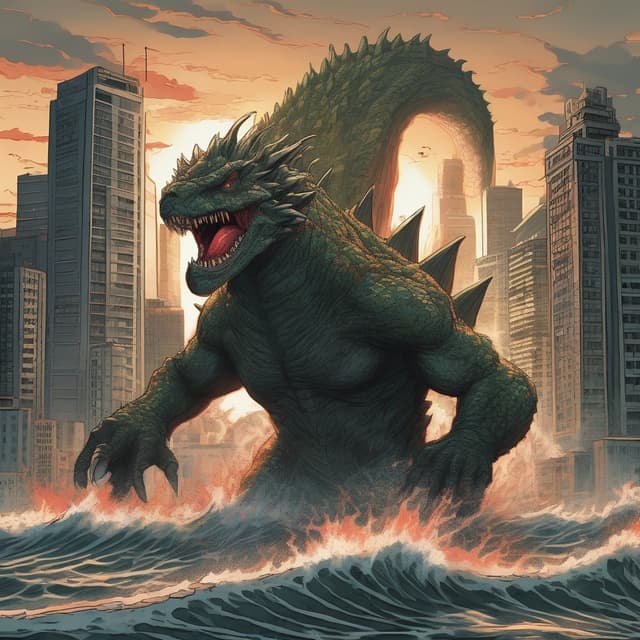
The Great Yokohama Disaster, which occurred on April 18, 1916, was the first major confirmed attack by a kaiju - a massive, powerful creature of unknown origin - on a human population. This cataclysmic event would set the stage for decades of struggle against the kaiju menace.
On that fateful day in 1916, a colossal, reptilian creature emerged from the depths of the Sea of Japan, striding onto the shores of the coastal city of Yokohama, Japan. Standing over 300 feet tall, the creature was unlike anything humanity had ever witnessed. With enormous jaws, thick scales, and a tail that could level entire city blocks, the beast quickly laid waste to the unprepared city.
Panic gripped the population as the kaiju, later dubbed "Godzilla" by the media, methodically destroyed key infrastructure, government buildings, and civilian areas. The Japanese military attempted to engage the creature with conventional weapons, but their tank shells, artillery, and even aerial bombardment proved entirely ineffective against Godzilla's sheer size and resilience.
By the time the beast finally retreated back into the sea after several hours of destruction, over 10,000 people had perished and much of Yokohama lay in ruins. The event shocked the nation and the world, revealing the terrifying power of these hitherto unknown kaiju.
The Great Yokohama Disaster spurred the Japanese government to take urgent action. Realizing that their conventional armed forces were woefully inadequate to combat the kaiju threat, they immediately began pouring resources into developing specialized anti-kaiju defense capabilities.
This included the creation of massive, bipedal mecha-like combat machines, experimental high-yield explosives, and even prototype energy weapons. Scientists also launched intensive studies into the biology, origins, and weaknesses of kaiju in hopes of better understanding and defeating them.
While these early efforts met with mixed results, they laid the groundwork for the increasingly sophisticated anti-kaiju technologies that would emerge in the coming decades. The disaster also prompted greater international cooperation, as other nations sought to emulate and improve upon Japan's pioneering work.
The Great Yokohama Disaster and the ongoing kaiju threat had a profound and lasting impact on Japanese culture. Kaiju imagery and motifs quickly permeated art, literature, film, and popular media, capturing the public's fascination and fear.
Iconic kaiju like Godzilla, Rodan, and Mothra became embedded in the national psyche, with devoted fans and extensive merchandising. Architects began incorporating kaiju-resistant design elements into buildings, while new industries emerged to produce specialized equipment and infrastructure for kaiju defense.
On a deeper level, the omnipresent threat of these titanic creatures has shaped the Japanese national psyche, fostering a sense of vulnerability and a need for constant vigilance. The unpredictable and destructive nature of kaiju attacks has also fueled philosophical and religious discussions about humanity's place in the natural world.
The kaiju phenomena continue to captivate and terrorize the Japanese people to this day, serving as a constant reminder of the fragility of human civilization in the face of such primal, unstoppable forces.
